
Real Estate Photo Editing Service | HDR Retouching & Property Enhancement | BrightImage Studio
Real Estate Photo Editing Service: Professional Property Image Enhancement That Sells Homes Faster and Commands Higher Prices
In real estate, buyers form their first impression of a property within 20 seconds of seeing its listing photographs. Professional photo editing determines what that impression is.
The property market has moved almost entirely online. Whether a buyer is searching on Zillow, Rightmove, Domain, or a luxury agency's private listing site, the photographs on the screen are doing all the work of a first showing. They are communicating the size, quality, condition, and desirability of the property before any human conversation begins. They are the listing's most powerful sales tool — and the most commonly underinvested one.
Real estate photo editing is not about making a property look like something it is not. It is about ensuring that the photographs communicate what the property genuinely offers — the natural light, the spatial volume, the quality of the finishes, the character of the outlook — with the accuracy and visual polish that serious buyers expect from a professional listing.
At Bright Image Studio, our real estate retouching service is built around one objective: delivering images that make buyers want to see the property in person. Everything else follows from that.
|
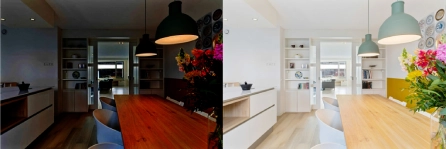
HDR Before/After — Interior, Full Width Comparison |
Why Real Estate Photo Editing Is a Commercial Necessity, Not a Cosmetic Option
The market has established the stakes with unambiguous clarity. Properties listed with professionally photographed and edited images sell on average 32% faster than those listed with unedited or amateur photography. Listings with premium visual presentation command higher asking prices and receive more qualified enquiries. On the buyer side, 95% of property searches now begin online, meaning that a listing photograph is not a supporting element of a property's marketing — it is the primary marketing channel.
For real estate agents and agencies, this means that the quality of listing photography is directly correlated with time-on-market and sale price achieved — two metrics that define professional reputation and client retention in this industry. For real estate photographers, it means that the post-production quality of delivered images is as commercially significant as the quality of the photography itself.
|
32% faster |
Average reduction in days-on-market for listings using professionally edited property photography versus unedited images. |
|
95% online |
Proportion of property searches that begin on digital platforms — where photograph quality is the primary selection filter. |
|
61% more views |
Additional online listing views generated by professional photography compared to smartphone-captured listing images. |
|
$3–11K more |
Additional sale price achieved on average for homes listed with professional photography, across multiple market studies. |
These numbers do not reflect an argument for luxury real estate only. They hold across market segments — from starter homes to multi-million dollar estates. The mechanism is the same: better images generate more enquiries, more enquiries generate more competitive offers, and more competition generates better outcomes for sellers. Professional property photo editing is an investment in those outcomes.
The Complete Real Estate Photo Editing Toolkit: Every Service, Fully Explained
Real estate image editing encompasses a range of distinct technical processes, each addressing a specific challenge created by the gap between what a camera captures and what the human eye experiences in the space. Here is an honest, detailed explanation of every service in our workflow — what it involves, why it matters, and what it achieves.
HDR Blending — The Foundation of Interior Real Estate Photography
High Dynamic Range blending is the core technical process that makes professional interior real estate photography possible. The fundamental challenge of interior photography is one of exposure range: a room lit by natural light through windows may have a difference of 10 to 15 stops between the brightest highlight (the outdoor view through the window) and the darkest shadow (the interior corners away from the light source). No single camera exposure can capture both correctly.
HDR blending resolves this by combining multiple exposures of the same scene — typically three to seven shots bracketed at different exposure values — into a single composite image where every part of the scene is correctly exposed. The interior is bright and detailed. The window views are properly exposed rather than blown out. The shadow areas are open and clear. The ceiling and floor both hold their texture and tone.
Our HDR blending process at Bright Image Studio is manually worked — not automated through HDR software presets that produce the characteristic over-saturated, haloed look that identifies cheap HDR processing instantly. We blend exposures using luminance masking in Photoshop, making selective decisions about which exposure to draw from in each area of the image. The result is a photograph that looks like how the room actually appears to the human eye: naturally lit, spatially clear, and visually inviting.
|
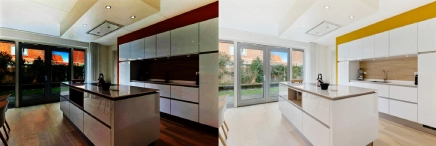
HDR Blending Before/After — Overexposed/Underexposed vs Balanced Composite |
Window Pull Editing — Showing the View That Sells the Property
Window pull — also called window masking or window replacement — is the technique of replacing a blown-out or featureless window in an interior shot with a properly exposed exterior view. It is one of the most commercially significant editing techniques in real estate photography, because windows are among the strongest selling features in any property. A city skyline view, a garden outlook, a mountain backdrop, or even simply the visible presence of trees and natural light transforms the appeal of an interior image.
Professional window pull editing requires photographing both the interior and the exterior view separately — the interior exposed for the room, the exterior exposed for the outdoor scene — and compositing them with precise masking that accounts for the physical characteristics of the glass: reflections, slight distortions, depth of frame, and any curtain or blind elements at the window edges. Done correctly, the result looks photographically natural: the window reads as part of the room's light rather than as a separately inserted image.
We work with window pulls at the pixel level, ensuring that glass reflections are preserved where appropriate (for authenticity), that the color temperature of the exterior scene matches the interior lighting context, and that the perspective of the exterior image correctly aligns with the angle and position of the window in the frame.
Sky Replacement — Transforming Exterior Property Images
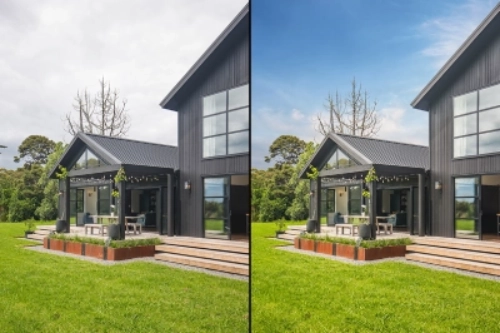
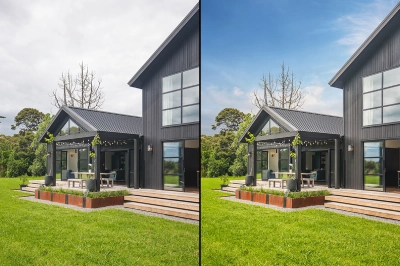
Exterior real estate photography is hostage to weather in a way that interior photography is not. A shoot scheduled for a property with a premium outlook can be compromised by overcast conditions, flat grey skies, or the kind of hazy midday light that removes all drama and depth from the image. The property itself may be photographed perfectly — sharp, well-exposed, correctly framed — but the sky tells a story of an average day rather than the property at its best.
Sky replacement in professional real estate image editing replaces an unflattering sky with one that enhances the property's visual impact without misrepresenting the physical characteristics of the location. This is a technically precise process: the sky must be extracted with accuracy around rooflines, trees, and architectural edges without fringing or artificial transitions. The replacement sky must match the lighting direction and color temperature implied by the foreground — a golden-hour sky cannot be dropped into an image lit by flat midday light without the inconsistency being obvious. The horizon line must sit correctly relative to the property's position in the frame.
At Bright Image Studio, our sky replacement work uses path-based masking for defined architectural edges, luminance-based extraction for complex tree canopies and detailed rooflines, and lighting adjustment on the property to ensure that the sky and the building tell a consistent atmospheric story. We maintain a curated library of sky reference images organized by light quality, time of day, and atmospheric character — ensuring that every sky replacement is contextually appropriate for the property type and geographic location.
|
Sky Replacement Example — Suburban, Luxury Property Exterior |
Perspective Correction — The Geometry of Architectural Credibility
Architectural perspective distortion is an inherent consequence of photographing buildings and interiors with wide-angle lenses — which real estate photography requires for spatial coverage. Vertical lines converge toward the top of the frame, creating the impression that walls are leaning inward or that a building is falling backward. Horizontal lines bow at the edges of the frame. Rooms appear trapezoid rather than rectangular.
These distortions are accepted as photographically normal but are perceived subconsciously by viewers as making spaces appear smaller, less stable, and less premium than they are. Perspective correction — both the automated correction of lens distortion and the manual correction of keystone and vertical convergence — restores the geometry of the space to its actual proportions. Rooms look as large as they are. Buildings stand as straight as they are built. The spatial impression conveyed by the image matches the spatial experience of the actual property.
Interior perspective correction is particularly significant for high-ceiling rooms, open-plan spaces, and properties where the spatial volume is a key selling feature. For architectural photography — commercial properties, luxury developments, and new builds — perspective accuracy is not optional: it is the technical standard that defines professional work in this category.
Object Removal — Eliminating What Should Not Be There
Real properties are lived-in spaces. They contain bins, garden hoses, vehicles parked on driveways, temporary signage, electrical infrastructure, and the accumulated visual noise of occupancy. In exterior shots, a neighbour's car visible at the driveway edge, a power line crossing the sky above the property, or a waste bin left outside significantly dilutes the presentation of an otherwise excellent image. In interior shots, personal items, cleaning equipment left in view, and temporary objects that cannot be moved during the shoot all require removal.
Object removal at the professional real estate editing level requires understanding of the scene geometry behind the removed object — the perspective, the lighting, the surface texture that should be present where the object was. Simply cloning adjacent pixels produces results that are detectable and unconvincing. Our object removal work reconstructs the scene behind the removed element using a combination of content-aware tools, manual cloning at high magnification, and perspective-matched texture reconstruction. The finished result should make it appear as though the object was never there.
|
Real Estate Image Editing: Object Removal |
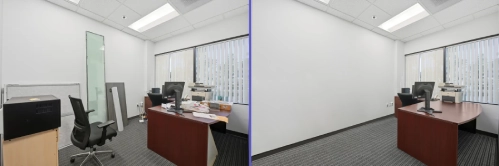
Lighting Balance — Creating Visual Invitation in Every Room
Even with excellent HDR blending, interior lighting often requires additional correction to match the way a well-designed space actually looks and feels. Artificial light sources — tungsten ceiling fixtures, LED downlights, pendant lamps — create warm-toned pools that compete visually with the cooler natural light entering through windows. Corners receive less light than central areas. Low ceilings can look darker than they should. Reflective surfaces create hotspots that distract from the architecture.
Lighting balance in our real estate photo editing workflow addresses these issues through selective dodge and burn (brightening shadow areas and reducing hotspots), color temperature correction on mixed light sources, artificial light replacement or enhancement (making ceiling fixtures appear to contribute warm, natural illumination rather than appearing as harsh yellow spots), and the careful restoration of spatial depth through tonal graduation from window light across the room interior.
Color Enhancement — Accuracy, Saturation, and Spatial Appeal
Real estate color enhancement serves a different purpose from fashion or product color work. The goal is not creative color grading — it is accurate, vibrant, spatially honest color that makes the property look its most appealing version of itself. Grass should be green, not the yellow-grey that overcast shooting produces. Wooden floors should carry their warm honey tones, not the blue shift that daylight-balanced cameras introduce in north-facing rooms. White walls should be white — not the grey-blue that camera sensors render in rooms without strong direct light.
Our color enhancement for property images works at the selective color and HSL level, adjusting specific color ranges without affecting the overall image color balance. We work to reference standards for common interior finishes — hardwood floors, painted walls, stone surfaces, kitchen cabinetry — ensuring that the delivered images represent these elements accurately and attractively. For exterior work, lawn color, rendered wall colors, brick tones, and landscaping all receive specific attention.
|
The Bright Image Studio Standard for Real Estate Editing Every property image we deliver represents our assessment of what that specific space looks like at its absolute best — accurately, professionally, and to the standard that premium real estate presentation demands. We do not fabricate features or misrepresent properties. We ensure that what the property genuinely offers is communicated as clearly and compellingly as the photography allows. |
People Also Ask: Real Estate Photo Editing
What is HDR editing in real estate photography?
HDR (High Dynamic Range) editing in real estate photography is the process of combining multiple exposures of the same interior shot — taken at different exposure settings — into a single composite image where every area of the scene is correctly exposed. The technique is necessary because cameras cannot capture the full range between the bright light outside windows and the darker interior in a single exposure. The result of good HDR blending is an image that resembles how the human eye actually perceives the room: the interior is bright and detailed, and the windows show their views rather than blowing out to white.
Is sky replacement in real estate photography ethical?
Sky replacement is widely accepted in real estate photography provided it does not misrepresent the property's actual characteristics — for example, by replacing a sky to obscure an adjacent building or industrial feature that would affect buyer decisions. The general professional standard is that sky replacement should represent the property under conditions that could realistically occur at that location: a genuine blue sky rather than the overcast conditions during the shoot is a legitimate enhancement. Most real estate photography associations permit sky replacement as a standard post-production practice. If in doubt, the test is whether the change would mislead a reasonable buyer about the physical characteristics of the property or its immediate environment.
How long does real estate photo editing take?
Standard real estate photo editing at Bright Image Studio — covering HDR blending, perspective correction, color enhancement, and lighting balance — is delivered within 24 hours for standard property shoots of up to 30 images. Larger shoots, properties requiring extensive window pull work or sky replacement, or commercial and architectural projects may require 24 to 48 hours. Rush 12-hour delivery is available for agents with time-sensitive listing schedules. Our turnaround commitments are built around the reality that real estate listings are time-critical — a delay in image delivery is a delay in listing launch, which has direct commercial consequences.
What is the difference between HDR and flash photography in real estate?
HDR photography captures multiple exposures using ambient light and blends them in post-production. Flash photography (specifically, flash ambient blending or strobe work) uses artificial light sources to fill the interior with controlled illumination during the shoot, reducing the dynamic range challenge at capture and requiring less post-production work per image. Both approaches are professionally valid and each has advantages depending on the property type and shoot conditions. HDR tends to produce warmer, more natural-feeling results that preserve the ambient character of a space. Flash work can be faster on location and produces very clean, even exposure across difficult rooms. Most professional real estate photographers use both techniques depending on the specific property and the time of day of the shoot.
How much does professional real estate photo editing cost?
Professional real estate photo editing pricing varies based on the number of images, the services required, and the complexity of the property. Basic HDR blending and color correction for a standard residential shoot typically starts in the range of $1.50 to $3.00 per image at volume. Premium services including window pull editing, sky replacement, object removal, and virtual staging carry additional costs. Bright Image Studio offers transparent per-image pricing and per-project quotes — contact us with your shoot details for a specific number without hidden additions.
|
Listings Go Live Faster with Professionally Edited Images — Bright Image Studio Delivers in 24 Hours. Request a Free Sample Edit. |
Smartphone Photos vs Professionally Edited Images: What the Difference Actually Costs You
The gap between a smartphone property photograph and a professionally photographed and edited listing image has never been more commercially significant. Buyers have been trained by exposure to thousands of high-quality listing images to make immediate quality judgements based on photography — and those judgements extend to the property and the professionalism of the representing agency.
|
Smartphone / Unedited Photography |
Professional Photography + Bright Image Studio Editing |
|
Interior dynamic range blown out at windows |
HDR blending balances interior and exterior exposure perfectly |
|
Colour casts from mixed artificial lighting |
Colour temperature corrected for every light source in frame |
|
Perspective distortion makes rooms look smaller |
Vertical and horizontal correction restores true spatial proportions |
|
Sky flat or overcast in exterior shots |
Sky replacement delivers property at its atmospheric best |
|
No window view visible in interior shots |
Window pull editing shows outdoor views and natural light source |
|
Objects and distractions in frame |
Professional object removal cleans all unwanted elements |
|
Inconsistent quality across the listing gallery |
Consistent tonal, colour, and quality standard across every image |
|
Buyer perception: amateur listing, lower value |
Buyer perception: professional listing, property credibility |
|
Reduced online listing engagement |
61% more views, faster enquiries, faster sales |
HDR vs Flash Photography for Real Estate: Making the Right Choice
This is one of the most discussed technical questions in professional real estate photography, and it is worth addressing with some nuance rather than a winner-takes-all verdict. The comparison matters to our editing clients because the shooting method directly affects what post-production can achieve.
|
HDR Ambient Blending |
Flash / Strobe Ambient Technique |
|
Multiple exposures, no artificial light required |
Single or multi-light exposure using portable flash or strobes |
|
Preserves natural ambient atmosphere of the space |
Produces clean, even illumination — can feel more clinical |
|
More post-production time per image |
Less dynamic range to manage — faster editing workflow |
|
Works well in large spaces with good natural light |
Particularly effective in dark rooms and windowless spaces |
|
Windows often require separate pull editing |
Can balance interior and window exposure in fewer brackets |
|
Ideal for lifestyle-feel residential properties |
Preferred by many architectural and commercial photographers |
|
Requires consistent still conditions between brackets |
Single capture — no movement artefacts between exposures |
|
Our HDR blending service optimised for this method |
Our flash ambient service handles this workflow natively |
|
Our Recommendation The best real estate photographers use both methods situationally. HDR for natural-light-rich interiors and premium residential properties where atmosphere matters. Flash ambient for dark rooms, commercial spaces, and properties where shot-to-shot consistency across a large portfolio is a priority. Regardless of your shooting method, our editing team is trained in both workflows — just tell us how you shot it and we will apply the correct editing approach. |
Real Estate Photo Editing for Every Type of Property Business
Real Estate Photographers
For professional real estate photographers, post-production is the hidden overhead that limits how many shoots you can take per week and how profitable each one is. A photographer completing five shoots weekly, spending four to six hours editing each, is investing 20 to 30 hours weekly in post-production — often at the expense of marketing, new client development, and the quality of life that led them to the profession.
Our outsourced real estate photo editing service for photographers operates as a seamless extension of your workflow. Upload your RAW files at the end of the day. Receive fully edited, client-ready images within 24 hours. Deliver to your client. Repeat. We match your editing style precisely, maintain consistency across all your property clients, and free you to focus on what you do best: the photography.
Real Estate Agencies and Property Agents
Real estate agencies with an in-house photography function — or those working with multiple preferred photographers — need a consistent editing standard across their listing portfolio. The visual quality of listing images is a direct reflection of the agency's professional standards, and inconsistency across listings undermines the brand authority that premium agencies work to establish.
We work with agencies to establish a property image style guide — covering tonal quality, colour standard, HDR approach, and sky replacement protocol — and apply it consistently across all listings regardless of which photographer or property type is involved. For high-volume agency accounts, we build capacity to handle seasonal peaks and simultaneous new listing launches without compromising turnaround times.
Airbnb and Short-Term Rental Hosts
Airbnb's own research has shown that listings with professional photography earn on average 40% more revenue than those with amateur images. For short-term rental hosts, professional property photo editing is one of the highest-return investments available. The photography drives booking rate, average nightly rate, and the review quality that determines long-term platform visibility.
Our Airbnb and short-term rental editing service focuses on the specific requirements of this platform: inviting, warm interior images that communicate comfort and quality, exterior images that establish context and curb appeal, and detail shots of amenities and finishes that set accurate and attractive expectations. We also optimise image dimensions and file sizes for platform upload requirements.
Interior Designers and Property Stylists
For interior designers documenting completed projects for portfolio, publication, and client presentations, the standard of architectural photography and editing reflects directly on the standard of their design work. A beautifully designed room photographed and edited poorly diminishes the design. The photography and post-production are the medium through which the design work is communicated to the world.
Our architectural photo retouching service for designers and stylists focuses on faithful, beautiful representation of designed spaces: accurate material colours (fabric, paint, tile, timber), balanced lighting that honours the design's intended atmosphere, perspective correction that preserves the spatial intent of the layout, and the removal of any styling imperfections or photographic distractions that would detract from the finished work.
Commercial Real Estate and Architectural Photography
Commercial real estate photography — office buildings, retail spaces, hospitality properties, industrial facilities, and new development projects — operates to a different visual standard than residential work. The audience is professional: developers, investors, corporate tenants, and institutional buyers who evaluate spaces with a different set of criteria. The images must communicate scale, quality of construction, spatial efficiency, and design authority with architectural precision.
Our commercial real estate editing service handles the specific demands of this category: precise vertical and horizontal perspective correction for building exteriors, advanced HDR blending for large commercial interiors with complex lighting infrastructure, sky replacement calibrated to the character of commercial architectural imagery, and the tonal and colour quality that aligns with architectural publication standards.
|
Every Property Deserves to be Seen at Its Best — Contact Bright Image Studio for a Free Sample Edit on Your Next Shoot |
Why Property Professionals Trust BrightImage Studio
Real estate photographers and agencies work to tight turnaround expectations from clients who have their own commercial pressures. An editing service that cannot deliver consistently, accurately, and on time creates problems that cascade through every relationship in the chain. We have built our service around the operational reality of real estate photography — which means reliable delivery, consistent quality, and direct communication when anything requires attention.
|
Industry Expertise |
Our editing team specialises exclusively in real estate and architectural photography — not a generalist service moonlighting in property images. |
|
Technical Precision |
Every image is worked by a trained specialist with deep knowledge of HDR blending, perspective geometry, and interior lighting physics. |
|
Reliable Turnaround |
Standard 24–48 hour delivery. Rush 12-hour service available. We build our capacity around your shoot schedule — not the other way around. |
|
Data Security |
Your property files are handled under strict confidentiality. Secure upload, encrypted storage, and deletion after delivery upon request. |
|
Revision Guarantee |
Two full revision rounds included on every order. If it is not right, we fix it — without charge, without friction. |
|
Any Format, Any Platform |
Deliver in MLS-optimized JPEG, high-res TIFF for print, or web-ready sets for Zillow, Rightmove, and luxury listing platforms. |
FAQ: Real Estate Photo Editing Service
Q: What shooting formats do you accept?
We accept all major RAW formats (CR2, CR3, NEF, ARW, RAF, DNG) as well as TIFF and JPEG. For HDR projects, we accept bracketed exposure sets in any of these formats. If you shoot tethered and work in a specific folder structure, we can accommodate your upload workflow. We also accept files from drone cameras for aerial property photography — including DJI and other manufacturers' RAW formats.
Q: Can you match the editing style I currently use?
Yes. Style matching is our standard onboarding process for all new real estate photographer accounts. We ask for a set of your best existing edited images, review your style preferences (warmth level, sky tone, HDR handling, colour saturation standard), and produce a sample edit from your shoot files before processing your first full order. Once your style profile is established, we apply it consistently across every order — regardless of property type or shoot conditions.
Q: Do you offer virtual staging?
Yes — virtual staging is available as an additional service for vacant residential properties, new build show units, and commercial spaces. Virtual staging digitally furnishes empty rooms with photorealistic furniture and decor, helping buyers visualise how the space can be used. Studies consistently show that virtually staged properties receive more online enquiries and sell faster than those listed with images of empty rooms. Contact us directly to discuss virtual staging requirements — pricing and turnaround depend on the number of rooms and the required staging style.
Q: How do I send files and receive edited images?
File transfer works via Dropbox, Google Drive, WeTransfer, or direct upload through our client portal — whichever fits your existing workflow. Edited images are delivered back to you via the same channel, organised in the same folder and naming structure as your original files. For regular clients, we set up a standing transfer protocol so that every project flows through the same efficient process without setup time on either end.
Q: What image format and resolution do you deliver?
Standard delivery is in full-resolution JPEG at maximum quality — suitable for MLS/portal upload, print, and client delivery. We can also deliver high-resolution TIFF for archival and large-format print use, web-optimised JPEG sets at specified pixel dimensions for platform upload, and DNG or XMP sidecar files for photographers who prefer to keep their edits as Lightroom adjustments on their RAW files. Specify your delivery format requirements at the time of order and we will configure accordingly.
Q: Do you edit drone and aerial property images?
Yes. Aerial and drone property images are a growing component of real estate listing galleries, particularly for larger properties, estate homes, and commercial real estate. We apply sky replacement, horizon correction, colour enhancement, and tonal balance to aerial images using the same precision as our ground-level work. Aerial sky replacement requires specific attention to matching the atmospheric perspective of the drone altitude — a consideration that generic sky replacement approaches handle poorly but our manual workflow addresses correctly.
Every Property Has a Best Version of Itself. Our Job Is to Find It.
Real estate is a market built on first impressions and professional credibility. The images on a listing are the first thing a buyer sees and the basis on which they decide whether to enquire. For agents, they are a direct reflection of the agency's professional standards. For photographers, they are the portfolio that determines the quality of the next client relationship.
Bright Image Studio's real estate photo editing service delivers the consistent quality, technical precision, and reliable turnaround that property professionals need to present their best work every time. Whether you shoot one property a week or 50, whether your portfolio spans starter homes or landmark estates, we have the expertise and the capacity to make every image work harder for you.
We offer a complimentary sample edit on your next shoot — a selection of your images, fully edited to the standard we have described in this guide, at no cost and no obligation. The quality of our work is the only argument we need to make.
|
Send Us Your Next Shoot Files — Free Sample Edit for New Clients. Bright Image Studio: Real Estate Photo Editing Delivered in 24 Hours. |